
October 2026


CHRIS ROBINSON
On A Wing of Intention
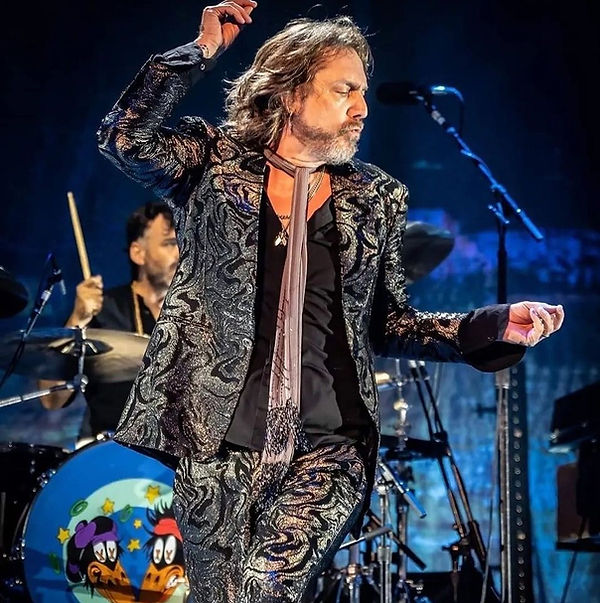
Photo Courtesy The Black Crowes, Facebook
"Every show feels like a gift in a way that I don't think I fully understood when I was young and burning through everything."
~Chris Robinson
I'm one of those people who enjoys seeing a lead singer dance like a kid on stage. Chris Robinson from the Black Crowes, and Mick Jagger of the Rolling Stones have that down pat. It's a voodoo soul dance conjured up by a soulful song and voice. You see it and you can't take your eyes off of the energy. In the 90's, when the Black Crowes arrived on the scene, their soulful sound was undeniable.
Chris Robinson's voice seeps rhythm and the grit that makes rock and roll come to life.The Black Crowes is and has been for years, a tight sound. The band's steely hooks and verses you long remember after the song has ended. You can't deny the strong lyrics either, "Can I have some remedy?" "She says she talks to angels," and the list goes on. They have done it again with their latest album, A Pound of Feathers, written by Chris and Rich.
The Black Crowes was founded by brothers Chris and Rich Robinson. They are multiplatinum GRAMMY® Award-nominated and rose to fame with their 5x-Platinum Shake Your Money Maker. Their path went on from seminal records with the 2x-Platinum Billboard 200 #1 LP The Southern Harmony And Musical Companion, and Gold-certified follow-up Amorica. Next, it was a once-in-a-lifetime jaunt with Jimmy Page with the accompanying Gold-certified live record: Live at the Greek. The band’s lore expanded with the chart-shaking Warpaint and Before the Frost…Until the Freeze. Their next chapter was 2024’s Happiness Bastards, which garnered a GRAMMY® Award nod for Best Rock Album. They even picked up a 2025 Rock and Roll Hall of Fame® nomination.
Chris and Rich wrote their recent album, A Pound of Feathers, in just ten days. It is already being enjoyed by old and new fans.
By Abbe Davis, May 2026
Abbe: Before your latest album, A Pound of Feathers, the Black Crowes won the 2025 Grammy nomination for Best Rock Album. That had to feel great. Congrats on that, also the Rock and Roll Hall of Fame nomination, and now, your new album, A Pound of Feathers. (recorded in Nashville with Jay Joyce, the same as Happiness Bastards).
This new album has the soulful, vibes I've always enjoyed of your band. I love "Profane Prophecy," and then "It's Like That" with the wicked bass. So many songs rock on this new album. I also liked that there was no Ai used. Your strong, recognizable vocal, yet in how you tend to craft songs, roots up, soul first, and then the rest follows like a badass force. What is your approach and mood whenever you begin crafting an album, in your view? When is it difficult to write? What goes on for you?
Chris: Man, you know, it's funny, I never really sit down and go, "Alright, time to make a record." It's more like... the songs find you. And when they do, you better be paying attention. Working with Jay again in Nashville felt natural, felt like home in a way. Same walls, same vibe, different songs wanting to come out.
The soulful thing, look, that's just who we are. That's the DNA. I grew up on Otis Redding and the Stones and Little Feat and all of that lives inside me whether I want it to or not. So when I start writing, I don't think about genre or marketability or any of that nonsense. I start from the inside and work out. Roots first, like you said. Soul first. When is it hard? When you're forcing it. When you're sitting there going, "I should write a song right now." That's the death of it. When it's easy? When life has been cracking you open. Pain, joy, confusion, those are actually the most generous teachers for a songwriter. The trick is staying awake enough to receive what's being offered.
Abbe: You and your brother, Rich, went from not speaking for years to a home run with A Pound of Feathers in just days. How did you both turn a corner?
Chris: You know, time has a way of doing what no conversation can sometimes. Rich and I, we're brothers. And brothers fight. We fought hard. But there's something underneath all of that which never really goes away, no matter how much silence piles up on top of it. I think we both just got tired of the weight of it. It's exhausting carrying something like that around. And when we finally got back in the same room together with guitars... The music just remembered what we forgot. That's the magic of it, right? The music knows before you do. Eight to ten days and it just poured out of us. I think we both knew we weren't going to waste the moment.
Abbe: A lot of alchemy. Your previous album, award winning, Happiness Bastards, was described as leaving the bullshit behind and leaning into your creative common ground. Which elements brought your band back to that, what was the formula that worked so well?
Chris: The formula was dropping everything that wasn't us.That's it. No over-producing, no chasing something external. Just what does this band actually sound like when nobody's trying to dress it up or sand down the rough edges? The rough edges are the point. The imperfection is where the soul lives. So with Happiness Bastards it was about getting back to the common ground, which for me and Rich has always been the music we loved as kids.That shared language. You get back to that and suddenly everything else falls away and you're just playing.
Abbe: indeed. The band reunited in 2019, played 150-plus shows across 20 countries, and now you're putting out back-to-back albums. Do you feel there's a creative urgency right now, like you're making up for lost time, or does it just genuinely feel this good?
Chris: Both, honestly. I'd be lying if I said there wasn't some fire under me, some feeling of, "Man, we let years slip by and those years had music in them that never got made." That stings a little. But more than making up for lost time, it just genuinely feels alive right now. 150-plus shows across 20 countries and the band locked back in, you feel it every night. The audience feels it. There's nothing manufactured about it. When it feels this good you don't pump the brakes.
Abbe: A few months ago you said publicly that using AI to write music "isn't songwriting" and you have expressed dismay that people are gravitating toward something "unreal" rather than seeking "soulful, dynamic human art." So then, how do people enjoy music without that, if they can't pick up music easily by ear, aren't musically inclined like you are, if they have always wanted to try to write just one song? Does it mean they should not use tools to have fun? Some people can study for years and may never be able to hear, realize, or write like you do. What is the solution then? Explain what's pissing you off about it for beginners or non-musicians?
Chris: OK, this is important and I want to be clear, because I think I've been misunderstood on this. My frustration isn't with people who love music and want to participate in it. God, please, everyone should participate in music. Everyone. What pisses me off is the cultural surrender. The idea that we should just hand the most human thing we do, expressing our inner world through sound, over to a machine and call that songwriting. It isn't. It's music generation. Which is a different thing.
Now look, if someone wants to use a tool to have fun, to make something, to play around? Fine. Do it. I'm not the music police. But don't confuse that with the act of songwriting, which is a deeply personal, deeply human, often painful process of excavating who you are and putting it out there exposed.
The thing that worries me is when people stop seeking the real thing because they've been fed something that looks like it. Real music, music made by human beings wrestling with human experience, has a quality that you feel even if you can't name it. And I don't want people to lose their appetite for that. You don't have to play guitar to write a song. Hum it. Tap it out. Use voice memos. The tools are fine. Just don't outsource your soul. That's the part that can't be automated.
Abbe: It is a lot of sampled sounds in songwriting, often these days. You've got a Rock & Roll Hall of Fame nomination. Do you agree with how they set it up? R&B artist, pop artist, combined? Would you ever wanna help and maybe have them separate it out, get all rock bands together to create one museum for Pop, one for R&B, and let the rock museum be just for rock music? I want to see that happen, how about you?
Chris: [laughs] Look, I'm grateful for the nomination, I really am. But yeah, the way it's structured has always struck me as a little... confused. You're throwing together artists from completely different traditions, different histories, different cultural contexts and going, "Here's the Hall of Fame." For what exactly?
Honestly, I'd love to see it more clearly defined. Let rock be rock. Let R&B have its own proper celebration with the full weight and reverence it deserves, because R&B built a lot of what we call "rock and roll." and it deserves to be honored on its own terms. Would I want to be involved in something like that? Sure, why not? I've got opinions. I'm not shy about 'em.
Abbe: (laughing) Yeah, I was counting on how you aren't shy. I hope maybe you and some of the heavy-hitters can get this going. What causes are ya working on, during what is such a Twilight Zone existence out there, you've done a lot of work on causes. What now?
Chris: Right now feels like a moment where you either show up or you don't, and I've never been good at looking away. The Rex Foundation, environmental work, human rights, these things don't take a day off because the political climate gets weird.
I'm staying engaged where I can and trying to use whatever platform I have to shine a light on people doing real work on the ground.
Abbe: Do you feel that currently your work with the Rex Foundation seems threatened in this now political, Twilight Zone climate? How are organizations working in environment, human rights, and the arts, being effected as per the Rex Foundation's efforts currently?
Chris: Oh, it's absolutely affected. Any organization working in environment, arts, or human rights is navigating a landscape right now that is actively hostile in some corners. Funding dries up, political pressure gets applied, people get scared. But the Rex Foundation has always operated from a grassroots, community-up philosophy and I think that actually insulates you a little from the top-down pressure. You're woven into communities in a real way. That matters. We keep going.
Abbe: Undoubtedly, working with the communities is the way to make those changes. Glad to hear that the Rex Foundation is going strong with grassroots. I realize you've criticized "over commercialism." In keeping with your ideas about it, how do we keep concert ticket costs lower? I recall Pearl Jam fighting for that for fans ages ago. With large conglomerates and let's face it, David Geffen isn't there going on tour with the rock bands anymore. Most corporate bigwigs don't care about bands or the fans as much. So then, how do bands get it back to more reasonable pricing of concert tickets while we all go thru this tough economy?
Chris: This one genuinely breaks my heart because rock and roll was supposed to be for everyone. It wasn't supposed to be a luxury experience. And now, you've got these massive corporate entities, Ticketmaster and all of that apparatus, treating live music like a commodity to be squeezed. What Pearl Jam did was brave and they took real hits for it. But they were right. You have to decide what you stand for and hold the line. Bands have more power than they think, when they're willing to use it collectively. The problem is the industry has made musicians feel powerless and dependent, and that's by design. I don't have a clean answer. But I know it starts with artists being willing to sacrifice some profit margin to keep the room accessible. And it starts with fans demanding better.
Abbe: Thanks for saying that, Chris. I hope ahead we can see that happen. You've done many charitable things in your own right, which matters so much to people out there. You "get it." Are you still involved with Arms Wide Open, for childhood cancer research and family assistance?
Chris: Always. That cause, childhood cancer, supporting those families, that doesn't ever leave you once you've been touched by it. Those families are going through the most unimaginable thing. If I can be of any use whatsoever, I'm there.
Abbe: How are you these days about Drug Reform laws?
Chris: I think we've been fighting a war on drugs that was always a war on people, and I've said so for a long time. Reform is long overdue, and the human cost of not reforming has been catastrophic, particularly in communities that never had the political protection to push back. We need to be smarter, more compassionate, and more honest about what addiction actually is.
Abbe: Absolutely true. Can you tell us some highlights from the Australia tour, or any funny encounters that went on?
Chris: Australia is always a ride, man. The audiences there have this wild, generous energy. They show up ready. I can't give away all of the funny stuff because some of it, you had to be there for, and some of it should probably stay in Australia. [laughs] But I'll say this, we had a night where everything that could go wrong technically did go wrong, and the crowd just willed us through it. That's what live music is. You can't fake that.
Abbe: How has touring changed for you from your 20's to now? How do experience it these days? How does it feel now?
Chris: In your 20s you're invincible and stupid, which is a beautiful combination. Honestly, everything is wide open and the road feels endless, and you'll sleep anywhere and eat anything. Now I'm more intentional about it. I protect my voice, I protect my sleep, I try to actually be present in the places we travel through, rather than just surviving them. I appreciate it more deeply now, I think. Every show feels like a gift in a way that I don't think I fully understood when I was young and burning through everything.
Abbe: The Southern Hospitality Tour with Whiskey Myers is a massive 40-plus city run this summer. What do you most look forward to about the upcoming experience? Also, thanks for this today, you're voice and the band has been very inspiring.
Chris: Whiskey Myers are the real deal. They come from a genuine place and I respect that enormously. What I'm most looking forward to is that exchange of energy, two bands who both actually mean it, sharing a bill night after night across 40-plus cities. The audiences are going to get something real. And for me, that's always the whole point. Thank you for these questions. Seriously. The fact that this music has meant something to people over all these years, that's everything. That's the whole reason.
Abbe Davis, Editor of TRR / Musician

Abbe Davis is editor of Tru Rock Revival magazine. Her single, Day of Colors is on Sirius XM stations, and nobody can figure out how it got there.
Abbe promotes on-the-rise bands internationally. Her past is steeped in Blues, Jazz and Rock music. Abbe has performed alongside legendary Blues artist, Buddy Guy with previous band, Southern Reach. She has had performances at TRR Festivals, and the Parkland Memorial concerts in Florida. Her band, Davis, will release their first grungy, hard rock album this Summer.